Monday, March 31, 2014

Average Heights

The other day I was feeling slightly short and really needed an ego boost. SO, I looked up the average heights in to world and rest assured I felt better about myself. I would still like an inch or so but whatever. Here are my results.


Country and average female height:

  • Argentina 161.03 cm (5 ft 3.4 in)
  • Australia 163.9 cm (5' 4.5")
  • Bahrain 154.7 cm (5' 1")
  • Belgium 163.3 cm (5' 4.3")
  • Brazil 158.0 cm (5' 2.2")
  • Cameroon 161.3 cm (5' 3.5")
  • Canada 161.0 cm (5' 3.4")
  • China (PRC) 154.5 cm (5' 0.8")
  • China 158.6 cm (5' 2.5")
  • Colombia 158.65 cm (5' 2.4")
  • Côte d'Ivoire 159.1 cm (5' 2.7")
  • Czech Republic 167.3 cm (5' 6.0")
  • Dinaric Alps 171.0 cm (5' 7.2")
  • Finland 164.7 cm (5' 4.7")
  • France 161.9 cm (5' 3.7")
  • Ghana 158.53 cm (5' 2.4")
  • Gambia 157.8 cm (5' 2.2")
  • Germany 165 cm (5' 4.9")
  • Guatemala (Maya people) 142.2 cm (4' 6")
  • Hong Kong 158.8 cm (5' 2.6")
  • Hungary, Debrecen 165.84 cm (5' 5.2")
  • Iceland 167.6 cm (5' 6")
  • India 152.4 cm (5' 0")
  • Indonesia 147.0 cm (4' 10.0")
  • Indonesia, East Bali 151.3 cm (4' 11.5")
  • Iran 160.0 cm (5' 3")
  • Iraq 155.8 cm (5' 1.3")
  • Israel 162.7 cm (5' 4.1")
  • Italy - Middle & North 163.2 cm (5' 4.2")
  • Italy - South 160.8 cm (5' 3.3")
  • Japan 158.8 cm (5' 2.6")
  • Korea, South 162.56 cm (5' 4")
  • Malaysia 153.3 cm (5' 0.4")
  • Malta 159 cm (5' 2.6")
  • Malawi 155 cm (5' 1.1")
  • Mali 160.4 cm (5' 3.2")
  • Mexico, State of Morelos 155 cm (5' 1.1")
  • Netherlands 168.7 cm (5' 6.4")
  • New Zealand 165.0 cm (5' 5")
  • Nigeria 157.8 cm (5' 2.1")
  • Norway 167.2 cm (5' 5.9")
  • Philippines 151.8 cm (4' 11.8")
  • Singapore 160 cm (5' 3")
  • South Africa 159.0 cm (5' 2.5")
  • Spain 161 cm (5' 3.3")
  • Sweden 166.9 cm (5' 5.7")
  • Switzerland 164.0 cm (5' 3.8")
  • Taiwan 159.68 cm (5' 2.75")
  • Thailand 157.3 cm (5' 1.9")
  • Turkey 161.4 cm (5' 3.5")
  • United Kingdom 163.7 cm (5' 4.4")
  • U.S. 164.1 cm (5' 4.6")
  • Vietnam 156

If you wish to read about weight in relation to height and body composition, see the page link, further down this page, listed under Related Questions. 
 

Country and average male height:

  • Argentina 174.46 cm (5 ft 8.6 in)
  • Australia 178.4 cm (5' 10.2")
  • Bahrain 165.1 cm (5' 5")
  • Belgium 176.6 cm (5' 9.5")
  • Brazil 169.0 cm (5' 6.5")
  • Cameroon 170.6 cm (5' 7.2")
  • Canada 174 cm (5' 8.5")
  • China (PRC) 164.8 cm (5' 4.9")
  • China 169.4 cm (5' 6.7")
  • Colombia 170.64 cm (5' 7.2")
  • Côte d'Ivoire 170.1 cm (5' 7")
  • Czech Republic 180.3 cm (5' 11")
  • Denmark 180.6 cm (5' 11.1")
  • Dinaric Alps 185.6 cm (6' 1.0")
  • Estonia 179.1 cm (5' 10.5")
  • Finland 178.2 cm (5' 10")
  • France 174.1 cm (5' 8.5")
  • Ghana 169.46 cm (5' 6.7")
  • Gambia 168.0 cm (5' 6.1")
  • Germany 178.1 cm (5' 10")
  • Guatemala (Maya people) 157.5 cm (5' 2")
  • Hong Kong 170 cm (5' 7")
  • Hungary, Debrecen 179.14 cm (5' 10.4")
  • Iceland 181.7 cm (5' 11.5")
  • India 165.3 cm (5' 5")
  • Indonesia 158.0 cm (5' 2.2")
  • Indonesia, East Bali 162.4 cm (5' 3.9")
  • Iran 174.24 cm (5' 8.6")
  • Iraq 165.4 cm (5' 5.1")
  • Israel 175.6 cm (5' 9.2")
  • Italy - Middle & North 176.9 cm (5' 9.7")
  • Italy - South 174.2 cm (5' 8.0")
  • Japan 171.2 cm (5' 7.4")
  • Korea, South 175.26 cm (5' 9")
  • Lithuania 176.3 cm (5' 9.4")
  • Malaysia 164.7 cm (5' 4.8")
  • Malta 169 cm (5' 6.5")
  • Malawi 166 cm (5' 5.3")
  • Mali 171.3 cm (5' 7.4")
  • Mexico, State of Morelos 167 cm (5' 5.7")
  • Netherlands 184.8 cm (6' 0.8")
  • New Zealand 177.0 cm (5' 9.7")
  • Nigeria 163.8 cm (5' 4.5")
  • Norway 179.9 cm (5' 10.8")
  • Philippines 163.5 cm (5' 4.4")
  • Portugal 172.8 cm (5' 8")
  • Singapore 170.6 cm (5' 7.2")
  • South Africa 169.0 cm (5' 6.5")
  • Spain 170 cm (5' 7")
  • Sweden 180 cm (5' 10.9")
  • Switzerland 175.5 cm (5' 9")
  • Taiwan 171.45 cm (5' 7.5")
  • Thailand 167.5 cm (5' 5.9")
  • Turkey 173.74 cm (5' 8.4")
  • United Kingdom 176.8 cm (5' 9.6")
  • U.S. 178.2 cm (5' 10.2")
  • Vietnam 167 cm

Hyperbolas

I was not here for this day in class and therefore have not much of an idea what is going on in this lesson. However thank God for these math blogs because i was able to look at my good friend Grace Kims math blog for some help in understanding. 
Here is what i learned!:

Center
The center will be (h,k)

Vertices
The vertices will be a units from the center point.
When the hyperbola is vertical...subtract/add a to the y value.
When the hyperbola is horizontal...subtract/add a to the x value.

Foci
The foci will be c units from the center point.
When the hyperbola is vertical...subtract/add c to the y value.
When the hyperbola is horizontal...subtract/add c to the x value.

Asymptotes
Use this formula to find the asymptotes:


 Graph the Equation. 
1. graph the vertices
2. count b from the center and draw points.
When the hyperbola is vertical...subtract/add b to the x value
When the hyperbola is horizontal...subtract/add b to the y value.
3. Draw a rectangle connecting these points.
4. Draw diagonal lines through the corners of the rectangle. These are your asymptotes.
5. Draw a hyperbola through the vertex, but not touching any of the asymptotes.

Rotations of Conics


This is one of those days where Miss V decided to make my life very difficult. But thats every day. Also she doesn't text us when we have a trig quiz. Im grumpy. Jk I love Miss V. Anyways. This is re-writing an equation to get a shift in the x and y axis. You need about 4 equations to be successful in this and a lot of paper because these problems are long. To solve these problems follow these steps: 
1. Solve for angle using cot(theta) = a-c/b use your unit circle to find the angle degree. 
2. Find the new x and y using the two equations below. These will give you x prime and y prime 
3. Substitute new x and y into the original equations. If this works the xy should cancel out. Be very neat becuase there is a lot of work. 

So far, we have only studied conics whose axes were parallel to the coordinate axes. Such conics can be written with the equation Ax 2 + Cy 2 + Dx + Ey + F = 0 . The coefficient of the xy term, B , equals zero when the conic's axes are parallel to the coordinate axes. When the axes of the conic are not parallel to the coordinate axes, we can still express the conic without using an xy term by rotating the coordinate axes to from a new plane. Instead of using the xy-plane, the conic can be expressed as a second degree equation ( Ax 2 + Cy 2 + Dx + Ey + F = 0 ) in thex'y' -plane. The new second degree equation of the conic, after the axes have been rotated, will look like this: A'x' 2 + C'y' 2 + D'x' + E'y' + F' = 0 . The advantage to doing this is that by avoiding an xy -term, we can still express the equation of the conic in standard form.
When a conic contains an xyterm, the x and y axes can be rotated through an angle of θsuch that they are once again parallel with the axes of the conic, thus eliminating the xyterm of the conic. A rotation of the coordinate axes looks something like this:
Figure %: The x and y axes are rotated through an angle of θ to their new position as the x' and y' axes.The newly rotated axes are called the x' and y' axes.
A point in the x'y' -plane can be expressed with x and y coordinates, and vice-versa, using the following conversion formulas:

x = x'cos(θ) - y'sin(θ)   
y = x'sin(θ) + y'cos(θ)   

x' = x cos(θ) + y sin(θ)   
y' = - x sin(θ) + y cos(θ)   

Here's an example problem: what are the x and y coordinates of the point (x',y') = (1, 0) in the x'y' -plane which is the xy -plane rotated an angle of radians? Using the formulas above, x = 1 cos() - 0 sin() =  , and y = 1 sin() + 0 sin() =  . So the x and y coordinates of this point are (,) .
To eliminate the xy term of a conic of the form Ax 2 + Bxy + Cx 2 + Dx + Ey + F = 0 in order to use its standard form and write it in an equation of the form A'x' 2 + C'y' 2 +D'x' + E'y' + F' = 0 , you must rotate the coordinate axes through an angle θ such that cot(2θ) =  . Once this is done, and θ is found, you can use the conversion equations above to change the x and y coordinates to x' and y' coordinates. Then standard form can be used and the foci and vertices will be easily recognizable--but they will be in the x' and y' coordinate system. When they are found, it is possible to convert back to x and y coordinates to sketch the conic.

How many licks does it take to get to the center of a tootsie pop?

I was always curious. Kinda Matthy too. 

Tootsie Roll Pops are known for the catch phrase "How many licks does it take to get to the Tootsie Roll center of a Tootsie Pop?" The phrase was first introduced in an animated commercial which debuted on U.S. television in 1970. 

No one knows. For the owl in the original commercial, it took three licks and then he bit into it. The whole point is that no one will ever know because you can't resist the great temptation of biting the candy shell to get to the center of a tootsie pop! 

Additional Input from Contributors:

  • This is one of the more profound questions ever posed to humankind and animal alike. To test this hypothesis correctly, you must stop counting the moment that the 'center' (the tootsie roll blob at the core of the pop) becomes exposed. That should be considered 'reaching the center'.
  • It depends on a variety of factors such as the size of your mouth, the amount of saliva, etc. Basically, the world may never know. According to the producers of Tootsie Poops the consensus seems to be between 600-800 licks
  • One...two...three... three.
  • I got a bag of tootsie roll pops once that seemed to be mis-manufactured, and the tootsie roll center was peeking out of the candy on almost all of them... so for that bag, the answer was one. If you wanted to get right to the center... there it was already. So it also depends on the pops you have. 
  • Scientifically: What you have to do is measure the amount of saliva you produce per lick, measure the volume of the Tootsie Pop, find the amount each lick your saliva takes away from the pop, and divide that much by the total volume of the Tootsie Pop.
  • From Tootsie Roll Inc.: "We've been asking the question since 1970. Many have tried to lick their way to the center of the Tootsie Pop, and many have failed for they couldn't help but bite into it. But for those proud few who do make it to the center, and manage to keep count of how many licks it takes, we hold a special place in our hearts."
  • I spent three hours counting with my friend we got 765, 902, 730, and 877. So on average about 800.
  • When asking this matter to theexpert on Tootsie pops, Chuck Norris, he explained to me that if you roundhouse kick the tootsie properly it will lick itself, so zero licks!
  • In an experiment by Miah and Dr. Shin, it was proposed that it takes, on average, 413 licks to get to the center (see links below)
  • There are many factors that would go into how many licks it takes such as:
  1. acidity of saliva
  2. coarseness of the tongue
  3. how much amylase (enzymes) you have in your mouth
  • Depends on how you lick it, below are some results
    Large licks:423
    Small licks:752

There are several factors, needless to say, even if it's the same person counting, the # of licks will differ at each attempt. If you wanted to look at it semi-scientifically, the number of licks needed depend on these factors: 

* Pressure per square inch the tongue is applied to the surface of the tootsie pop (TP) 
* The average amount of square inch in contact between tongue and TP 
* At what measurement from the center of the stick of the TP at which you declare that you have reached the center of the TP. 
* The rotation factor of the TP - if the eater continues to lick one specific portion only to reach the center faster - or if licks are distributed evenly around the outer surface area of TP. 

And to a lesser extent: 

* Ambient temperature 
* Use of teeth / or lack of teeth of eater 
* Hunger of TP eater 
* Boredom of TP eater 
* Age of TP
  • Lost count of licks
  • Ran out of time
  • Amount of saliva in the mouth
  • The lollipop expired
  • The temptation was to great and you bite down and took a bite
  • Tongue size

1, 2, 3, CRUNCH! 
The world may never know…

Elipses

Mathland was full of surprises today. Not really but here is some stttuuffff we learned in class. We learned about ellipses today. They are similar to parabolas. But ellipses are defined as a set of all points. They are again two equations to find the major horizontal axis, and the major vertical axis. With these equations you are trying to find the center, foci, and vertex. The center is (h,k) the major is 2a and the minor is 2b. We also learn to solve for the eccentricity which has the equation of e=c\a. Once again almost every problem will involve completing the square to get the x's on one side. And the y's on the other. See examples below from problems and equations to solve ellipses. 


Here is an overview of the important points. 

And after is an ellipse solved and graphed.


Conic Sections

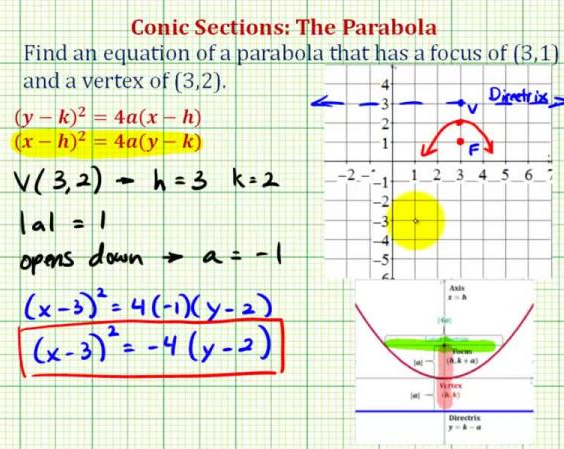
WOW! Class today was so interesting and fun. Miss V sure knows how to spice things up.....  Anyways, this lesson focuses specifically on conic section porabolas, a set of all points (x,y) that are equidistant from a fixed line (directrix) and a fixed  point (focus) not on the line. The midpoint between the focus and the directrix is called the vertex, and the line passing through the focus and the vertex is called the axis of the parabola. Using the definition of a parabola, you can derive the following standard form of the equation of a parabola whose directrix is parallel to the x-axis or to the y-axis. The vertex at (h,k), the standard form is: (x-h)^2 = 4p(y-k): vertical axis; directrix: y = k-p. (y-k)^2 = 4p(x-h): horizontal axis; directrix: x = h-p. The focus lies on the axis p units (directed distance) from the vertex. If the vertex is at the origin (0,0), the equation takes one of the following forms. x^2 = 4py: vertical axis. y^2 = 4px: horizontal axis. 

Here is an example of how to find the standard equation of a parabola:


Here is an illustration of how to find the focus:


And lastly a full example:


Monday, March 10, 2014

Math in Sports

I found this very interesting article on how math can be used in sports! I've always wondered when playing sports the math and probability of me hitting or scoring buckets. This is a very interesting piece about how mathmatical equations can quantify performance in sports ! Enjoy! 

Although not always realized, mathematics plays a very important role in sports.  Whether discussing a players statistics, a coaches formula for drafting certain players, or even a judges score for a particular athlete, mathematics are involved.  Even concepts such as the likelihood of a particular athlete or team winning, a mere case of probability, and maintain equipment are mathematical in nature.  


Let's begin by looking at the throwing of a basketball.  Now, we can use the equation


to help figure out the velocity at which a basketball player must throw the ball in order for it to land perfectly in the basket.  When shooting a basketball you want the ball to hit the basket at as close to a right angle as possible.  For this reason, most players attempt to shoot the ball at a 45o angle.  To find the velocity at which a player would need to throw the ball in order to make the basket we would want to find the range of the ball when it is thrown at a 45o angle.  The formula for the range of the ball is


But since the angle at which the ball is thrown is 45o, we have


Now, if a player is shooting a 3 point shot, then he is approximately 25 feet from the basket.  If we look at the graph of the range function we can get an idea of how hard the player must throw the ball in order to make a 3 point shot.


So, by solving the formula knowing that the range of the shot must be 25 feet we have


So in order to make the 3 point shot, the player must throw the ball at approximately 28 feet per second, 19 mph.


Now let's look at the throwing and hitting of a baseball.  The pitcher wants to throw the ball so that he will strike out the batter.  If his throw is too high or low then it is a ball and the better still has at least three more opportunities to hit the ball.  Similarly, when the batter hits the ball, he wants to hit the ball so that it will be as far away from any of the other players as possible if not outside of the ball field itself.  The players must take into consideration the speed and height of the ball to ensure that they will throw or hit it properly.  Here is the equation for finding the projectile motion of a baseball will travel:


where all distances are measured in feet, ho is the height from which the ball is thrown, α is the angle at which the ball is thrown, vo is the speed at which the ball is thrown, and x is the distance that the ball travels.  We can find the distance that the ball will travel by saying


Now, a batter would be more concerned with the range of the ball, wanting it to travel far enough to allow him to at least make it to first base safely.  Let's look at several graphs of the range with different α's and a fixed vo and ho. 


The black graph is when α = 30o, the blue graph when α = 45o, and the red graph when α = 60o.  So we can see from the graph that an angle of 45o will send the ball the furthest.  So, a batter would want to hit the ball as close to a 45o angle as possible, while a pitcher, who is more concerned about the ball veering off path, would want to throw the ball so the ball so that it would travel as close to a straight line as possible.

Now, let's say it is approximately 420 feet from home plate to the edge of a baseball field.  The batter wants to hit the ball hard enough so that it will travel out of the field, over the approximately 7 foot wall at the back of the outfield.  If the batter hits the ball at a 40o angle and the ball is approximately 5 feet in the air when struck, how hard must he hit the ball in order to have a home run?  Remember, that in the projection equation, f(x) is the height of the ball, so now we have


Therefore we have that the batter must his the ball at approximately 118 feet per second, which is approximately 81 mph, in order to hit a home run when he hits the ball at an angle of 40o.


We could also look at a sport such as bowling which many people consider to be quite simplistic.  However, you must consider the angle of the ball and the velocity with which the ball is thrown when trying to get a strike.  The path of a bowling ball, thrown in a straight line, can be represented by the following equation:


where vo is the velocity of the ball, t is the time in seconds that the ball travels, r is a constant represents the friction, and g(t) is the distance in feet that the ball travels after t seconds.

Now, the length of a blowing lane is approximately 60 feet.  Let's say that the friction caused by the bowling ball on the slick surface of the bowling lane is approximately 0.3 and the ball is rolled at approximately 15 mph, or 22 feet per second.  Now if we graph this equation we have


So we can see that the bowling ball, if thrown at 15 mph, should make it all the way down the bowling lane.


Mathematics is also used in ranking players and determining playoff scenarios.  From something as simple as using a matrix to the formulas used to determine a players or teams statistics, mathematics is an integral part of this system.  For example, in the olympics, most sports have players draw numbers to see who they will be competing against.  If there are 2kcontestants then all athletes participate in the first round of play, if not, then some of the participants enter during the second round of play.  The number of athletes entering during the second round of play will be 
2k - n, where n is the number of contestants.  Rankings are also an important aspect of sports.  In sports such as tennis, when rating athletes, an integral estimator is used which is based on a players performance in a series of matches over a certain period of time.  Even horse racing uses mathematics to rank the horses based on how well the have performed in previous matches, and these rankings go into determining the value of a horse when a bet is placed.  Mathematics is very prevalent in sports, from the most complex of formulas to the simplest ideas such as betting.


Return to Homepage